
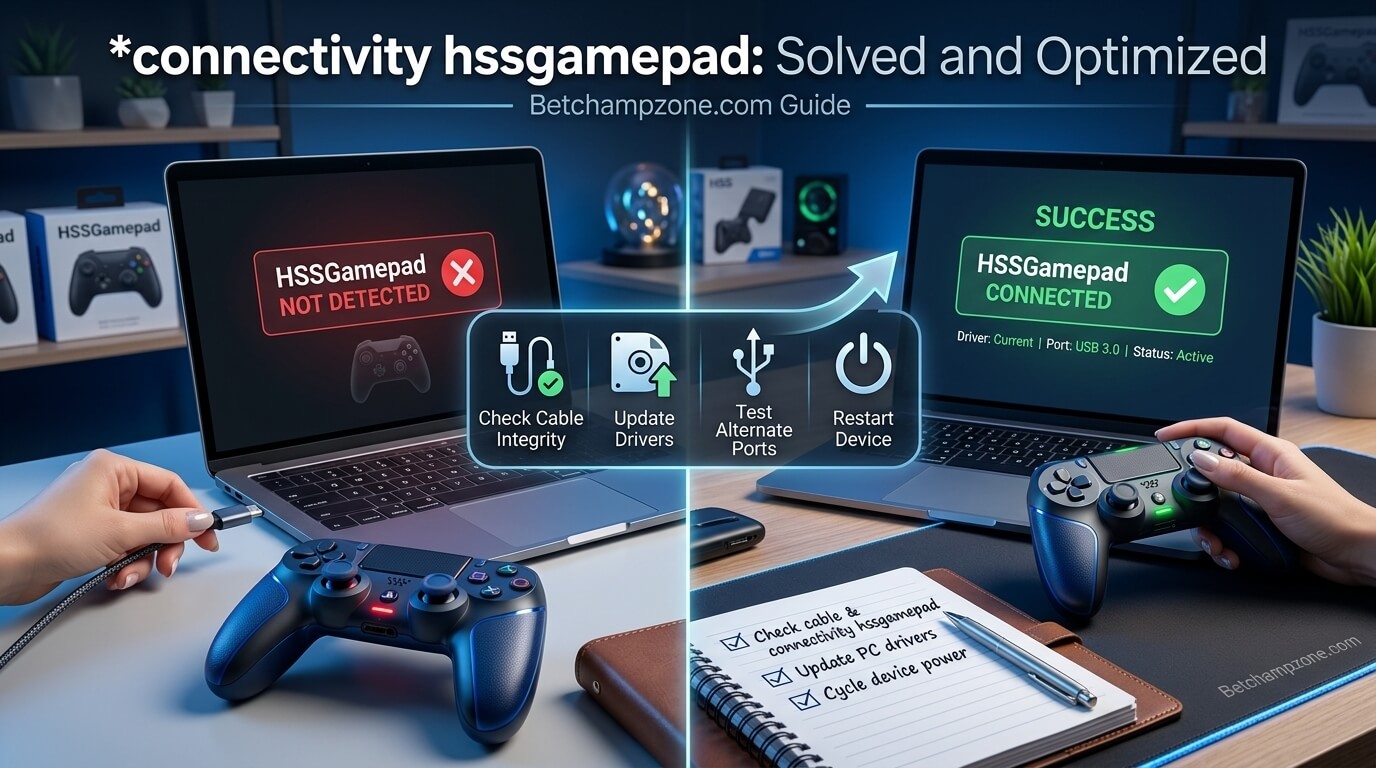
If you searched for “connectivity HSSGamepad,” you’re almost certainly trying to do one of two things: get the controller paired and working for the first time, or figure out why a connection that used to work has started dropping, lagging, or refusing to pair at all. This guide covers both — how gamepad connectivity actually works, what typically causes problems, and how to troubleshoot them systematically, regardless of which specific controller model you’re using.
What “Connectivity” Means for a Gamepad
A gamepad’s connectivity is simply the method it uses to send your button presses, stick movements, and trigger pulls to whatever you’re playing on. There are three broad categories, and most modern controllers — generic or branded — support one or more of them:
Wired (USB) connection. The controller plugs directly into a USB-A or USB-C port. This is the most reliable option because there’s no signal to interfere with and no battery to manage. The trade-off is obvious: you’re tethered to the device.
Bluetooth connection. The controller pairs directly with your phone, tablet, PC, or smart TV’s built-in Bluetooth radio. No extra hardware is needed, but Bluetooth is shared spectrum — it competes with Wi-Fi, other Bluetooth devices, and even microwaves for the same 2.4GHz frequency band, which is the root cause of a lot of lag and dropout complaints.
2.4GHz wireless dongle. Some budget and mid-range controllers ship with a small USB receiver instead of relying on Bluetooth. This creates a dedicated wireless link between the dongle and the controller, which tends to be more stable and lower-latency than Bluetooth because it isn’t sharing a general-purpose radio with a dozen other background connections.
If you’re not sure which type your controller uses, check for a physical switch on the device (often labeled wired/BT/2.4G or similar) and look for a small USB dongle in the box — that’s the clearest sign it supports the third method.
How Pairing Actually Works
For Bluetooth-based controllers, pairing follows a fairly standard sequence across brands: you hold a pairing button (often combined with a power button, or a dedicated small button near the top) until an LED starts flashing rapidly, which signals discovery mode. On the host device, you open Bluetooth settings, wait for the controller to appear in the list of available devices, and select it. Once paired, most controllers reconnect automatically the next time both devices are powered on and in range — you shouldn’t need to re-pair every session.
Dongle-based controllers usually pair out of the box; plugging the receiver in and powering on the controller is often enough. If it isn’t recognized, a manual re-sync (holding a pairing button on both the controller and the dongle, if one exists) is the standard fix.
Wired connections don’t require pairing at all — the device should be recognized the moment it’s plugged in, assuming drivers are already installed or the OS supports it natively (most modern game controllers use the standard HID or XInput protocols, which Windows, Android, and most smart TVs recognize without extra software).
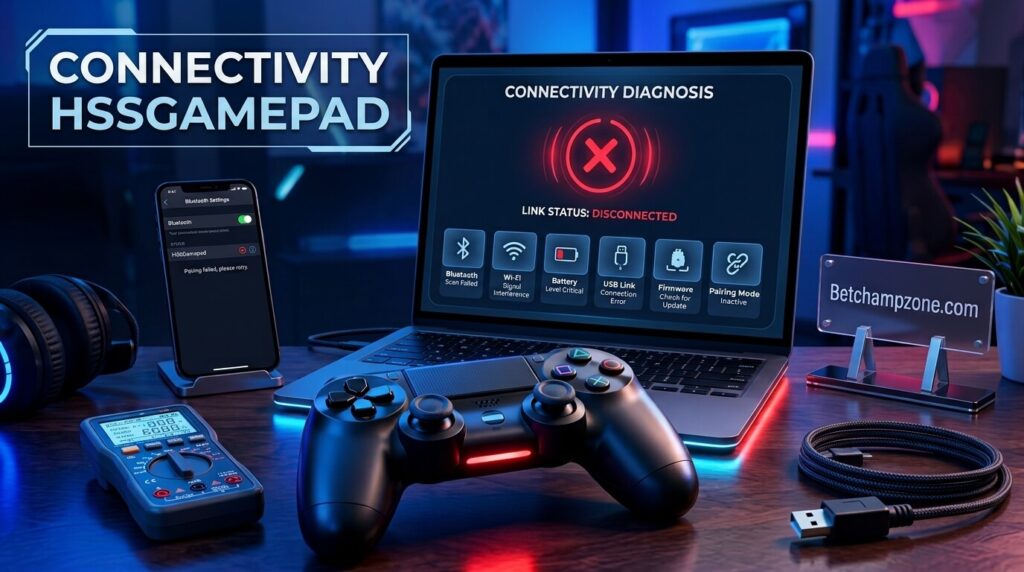
Common Connectivity Problems and Practical Fixes
The controller won’t enter pairing mode. Usually a battery issue. Rechargeable controllers that sit below roughly 10–15% charge often can’t power the Bluetooth radio reliably enough to broadcast a discoverable signal. Charge for at least 15–20 minutes before trying again.
It pairs but disconnects randomly. This is almost always interference or range. Bluetooth’s effective reliable range is shorter than its advertised maximum, especially through obstacles like walls, other electronics, or a crowded 2.4GHz environment (Wi-Fi routers, other Bluetooth peripherals, USB 3.0 ports — which are a documented source of 2.4GHz interference — and microwaves all compete for the same spectrum). Moving closer to the host device or relocating a USB 3.0 hub away from a dongle receiver often resolves this.
Input lag or delayed button presses. If you’re on Bluetooth, switching to a 2.4GHz dongle or a wired USB connection (where supported) will almost always reduce latency, since it removes the shared-spectrum bottleneck. If a dongle is already in use, try a different USB port — front-panel ports on desktop PCs are sometimes on a lower-bandwidth internal hub than rear ports.
The device isn’t recognized at all. On PC, this is often a driver or OS-recognition issue rather than a hardware fault — check Device Manager (Windows) for an unrecognized device warning. On Android, controller support varies by app; not every game supports external controllers even if the OS does, so test with a controller-tester app first to confirm the OS itself sees the device before troubleshooting further.
It worked before, then stopped after a system update. Operating system updates occasionally change how Bluetooth stacks or USB HID drivers behave. If this happens, check whether the controller has its own firmware and whether an update is available — and if not, a full re-pair (forgetting the device in Bluetooth settings, then pairing again from scratch) resolves the majority of post-update issues, since it clears any stale connection profile the OS is holding onto.
Practical Habits That Prevent Most Issues
A few habits meaningfully reduce how often you’ll run into connectivity trouble: keep the controller charged above 20% rather than running it to empty, avoid pairing it to more than one or two devices at a time (some controllers only remember a limited number of paired devices and will bump the oldest when a new one is added), and periodically clear the pairing and re-sync if you notice creeping lag over weeks of use, since Bluetooth connection quality can degrade gradually as background radio conditions change.
Frequently Asked Questions – Connectivity HSSGamepad
Does a gamepad need special software to connect?
Not usually. Most controllers use standard protocols (HID, XInput) that Windows, macOS, Android, and smart TVs already support. Some advanced features — like remapping buttons or adjusting vibration — may need a companion app, but basic connectivity doesn’t.
Can I use the same gamepad on PC and phone without re-pairing every time?
Yes, if the controller supports multi-device pairing — check whether it can store more than one Bluetooth profile at once, often indicated by multiple numbered pairing slots.
Is wired always faster than wireless?
For competitive or latency-sensitive play, yes — a wired connection removes both radio interference and Bluetooth’s inherent polling delay, making it the most consistent option when it’s available.
Conclusion
Most gamepad connectivity problems come down to a small set of causes: low battery, radio interference, an outdated driver or firmware, or a stale pairing profile. Working through those in order — charge, distance from interference sources, driver check, then a fresh pairing — resolves the large majority of issues regardless of which specific controller you own.
